Preface
The history of Idlewild, as related in the following pages is a attempt to record the beginning and the early days of the colony. The development of the Idlewild Incorporated Community following 1958 will be an other story and should be added.
Acknowledgments
At the 1980 regular meeting of the ldlewild Corporation the president appointed a committee to begin work on writing a history of the Idlewild Resort Colony. The secretary subsequently sent out questionaires to all property owners requesting information concerning their property: when and from whom lots were purchased, when and by whom the cabin was built, and any other information they might have concerning the history of the colony. The response was gratifying and has been used to tell the story as it is recorded.
The committee is grateful to all those who have assisted in anyway. A special thanks is due Maymie Marrs, caretaker, who has valuable first-hand information about the settlement from its beginning. She has graciously shared with us her records, her personal experiences, and her knowledge about the residents and their “happenings”. Mr. Harold Hunsaker loaned us the early records of Mrs. Gould, Treasurer and Mrs. Coleman, Secretary. Authentic data was taken from this source. Rev. Floyd Boulware, a former board president, was able to furnish material from his personal experiences. Natalie Sanders, a Idlewild resident since childhood, edited the entire copy and wrote The March of Progress, her reflections and personal experiences since 1935. Mrs. Lillian Jenkins has provided the beautiful artwork for our booklet.
The committee appreciates the interest and encouragement shown by the entire community in our effort to accomplish the task you gave us. Our work on this has been no less than a labor of love for the little bit of Heaven we call Idlewild. We trust that you will approve our offerings.
Committee:
– Maudeline Hutton, chm.
– Julia Putnam.
– Floyd Boulware.
– Jennie Waters.
– Jay Gould.
– Mary Lib Thornhill.
A middle-aged fisherman, wearing an orange-colored tee shirt bearing this bold inscription, caught the attention of a weary tourist who was on his way through Cimarron River Canyon. This traveler’s search for an answer to the intriguing question eventually led him to one of the most unique summer resorts in New Mexico.
Following a winding river road up over the Pass, he came suddenly upon a colorful panorama of
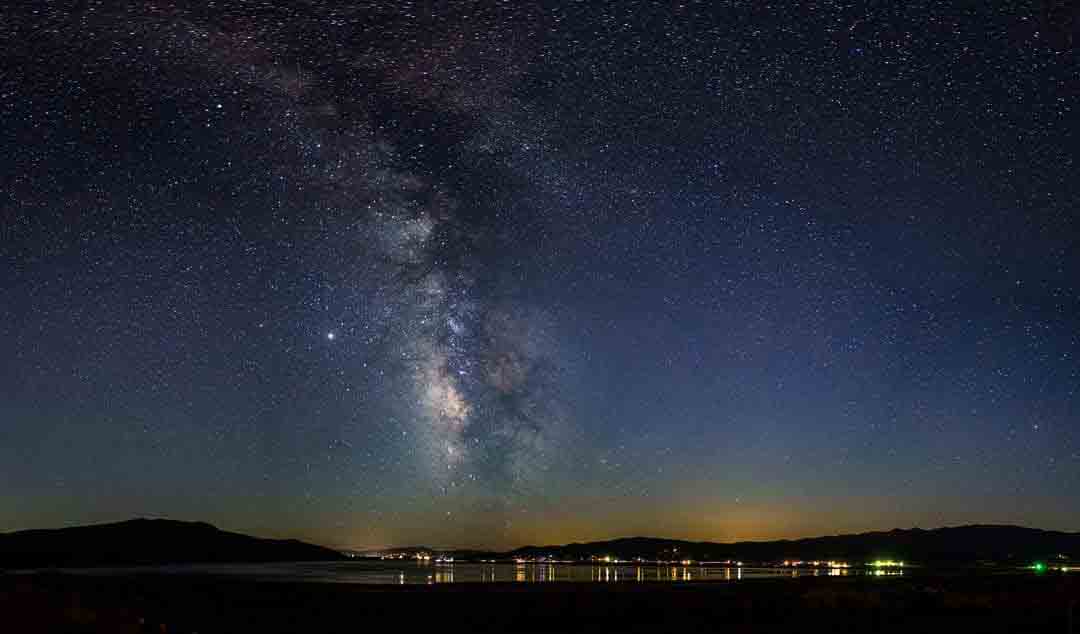
scenic beauty. Eagle Nest Lake mirrors the pine-and-spruce forested mountains towering above. Fisher men’s boats weave lacy patterns across the crystal blue water of the lake, which nestles comfortably within the protection of the miles-long MORENO VALLEY BASIN. Majestic mountains of the KIT CARSON NATIONAL FOREST enfold the valley. Lofty Wheeler Peak, the highest mountain peak in New Mexico, rises on the west; Baldy and Touch-Me-Not mountains stand guard over the scenic mountain road to Red River north and east of the valley. To the south, past Angel Fire, is Black Lake and a continuation of mountains and running streams. Highway Sixty-Four snakes through the little village of Eagle Nest (once known as THERMA), up and over the Pass to Taos, the famous art colony with its colorful Indian pueblo, and further south and west toward New Mexico’s capital, Santa Fe.
Making his first stop to browse at Mrs. Weather’s Antique Shop near the foot of the Cimarron Pass, the tourist learned that Idlewild is a few miles up the road toward the west and past the historic GALLAGHER RANCH headquarters. Up the bumpy dirt road past the ranch lie partly-secluded log cab ins, adobe structures, rock houses, two-storied chalets, modern ready-builts, “A-frames, and weather-worn slab cabins. A sign on a fence post indicates the entrance to Idlewild. (At one time the shape of a donkey was painted onto the sign as the logo for the colony.) A fence surrounds a modest slab cabin at the gate – the home of Mayme Marrs, care taker and permanent resident of Idlewild for forty years. Hers has been a labor of love for this colony for refugees from summer heat and the “rat race” pressures who have found re lazation and revival in the invogorating mountain atmosphere.
Originally the colony’s land was a valuable timber tract belonging to Mr. and Mrs. Charles Gallagher
who had homesteaded their ranch in the early part of 1900. Mae Gallagher was the daughter of Elizabeth and Joseph Lowery, and was born in ELIZABETHTOWN, named for her mother, Elizabeth Moore. Col. John Moore, Elizabeth’s father, had led an expedition from Fort Union to explore the “copper finds” on the high slopes of Mount Baldy. When gold was discovered on Willow Creek, hordes of gold-hungry settlers crowded into the valley; eventually ELIZABETHTOWN became a thriving city of 10,000. Mae Lowery and Charles Gallagher were married in 1908, later acquired the ranching land, and established the home where their children were born and reared.
During the Depression of the Thirties, Mr. Gallagher sold one-hundred-sixty acres of the 1 760-acre ranch for ten dollars an acre to Mr. Tom Cook, a genial cattle buyer and businessman from the Texas Pan handle. Mr. Cook built a small cabin near the west boundary of the acreage not far from the main road to the Klondike mine. Later he brought his family and began development of the land into an “ILDEWILD” for himself, his family, his relatives, and his friends. Dave and Frank Stribling, also from Texas, were en gaged to survey the tract. Lots 25′ x 100′, sixteen lots to the block with easements of twenty feet, resulted in 144 blocks being sold as building sites for future dwellings.
Mr. Dave Stribling was named caretaker, surveyor, and builder for the project. At first a small cabin near the Cook’s was erected for him; later a larger place was provided for his family at the entrance to Idle wild. This remained the Striblings’ home for many years. In due time, Mr. Cook built a larger family home with necessary out-buildings and stables for his horses. (After her husband’s death, Mrs. Cook retained her residence in Idlewild for many years until tlie home was finally sold to Mr. Murphy from Albuquerque. Pat Wallen now owns the property, and may be seen exercising her beautiful horses daily.)
As prospect improved for the development of his project, Mr. Cook employed J.W. Dickerson to take over the task of selling lots to prospective buyers. He built his cabin on the southwest tract which be came known as the J.W. DICKERSON DIVISION. His brother, Ray Dickerson, came to assist with the sales, building his cabin in the north part of the acreage near the present site of the worship Center. Lots sold for FIVE AND SIX DOLLARS and enthusiastic buyers began building in various sections of the tract. Lumber was hauled over unimproved roads from nearby saw mills. Slabs were used as siding because they were cheap, suitable for the climate, and were readily available. Structures were hastily erected with little
framework but were girded about the center with 2 x 4’s; rough plank floors were laid, and composition roofs covered the one-or-two-room houses. Some of the furniture in these early cabins was hand-made of rough lumber. Kerosene lamps lighted the rooms, and WPA “projects” at the end of a rocky path provided the “necessary.” Water was a very real problem. It had to be carried or hauled in buckets from the creek and nearby streams. Window callers covered with wire screen and placed on the cool side of the house· served as refrigerators. Some people were able to afford ice boxes which accommodated ice cut from the lake or streams during the winter and stored in ice houses in Eagle Nest for summer consumption. Getting furniture, building supplies, household equipment, and water barrels and gutters was an enourmous task; consequently, most people chose to make-do with meager conveniences while enjoying the novelty of “roughing-it.”
More people came to build cabins in the colony. Some built on the east ridge, others settled into the valley below. Building roads was a major problem, but somehow people managed to get where they wanted to locate their cabins. Some of the early builders were Mr. and Mrs. Wooley, Mr. Blanchard, the Simons, and Judge Stinson. Later, Mrs. A.R. King bought the Wooley place, Andy Wolverton was owner of the Blanchard cabin, and at a much later date, Mr. Orr bought Judge Stinson’s place, rebuilding it into a large modern house. Rev. W.K. Waters and Rev. Don Harrell bought lots and built cabins further out on the point. Glenn and Crace Pool built a log house in the area below the rldge and soon others began to settle in the valley.
In 1932, Mrs. Pearl Gould of Amarillo, her children Mary Evelyn and Jay, built a cabin on the south slope of the northwest hill, one of the first in that section. In 1935, Mr. Middleswart and his father from Wichita, Kansas, erected their cabin further down the mountain near the hourseshoe bend of the main road. In the early 1930’s, Judge Grigsby from Perryton, Texas, bought a block of lots in the southwest division for fifty dollars. There he built his two-room cabin for $700.00 in i934. About the same time, Mrs. W.A. Johnson from Canadian, Texas, purchased lots along the south side of the creek below the J. W. Dickerson and Grigsby cabins. Her cabin, erected by Mr. Stribling, is now the property of Mr. Bob Meaker.
Mr. Ivey Duncan of Pampa, Texas, bought all of Mrs. Johnson’s lots extending form her house to the fence boundary of Mr. Stribling’s property. In 1936, Mr. Duncan drew up the plans and Mr. Stribling started construction of his two-storied cabin. Mr. Bonnie Rose, also of Pampa, bought some of Mr. Duncan’s extra lots, contracted with Mr. Stribling to build his house by Mr. Duncan’s plans, and, at the same time, the twin-houses appeared near the creek. The Locke families of Miami, Texas, built their cabin next door to Mr. Stibling’s early in the 1930’s. Their lots were bought from Mr. Cook; Mr. Stribling did the building. By this time, there were twelve to fifteen cabins scattered throughout the tract. One of these is still owned and occupied by the Bratton family of Fr. Worth. It was erected in 1932 by Mr. Stribling at a cost of $600.00. Bill Bratton’s grandchildren now represent the fifth generation of that family to continue living in this summer home.
It is almost impossible to list all the wonderful people who found their way to ldlewild during the early years, but most of them had the same dream – – a place to “get away” from it all. Dr. Streit of Amarillo bought .his lots about 1936 and started construction of his big white house near the J.W. Dickerson cabin, at that time owned by the Preston Huttons. TheStreit house was added to until it is one of the largest houses in the southwest part of the colony. The Wilbur cabin on the main road near the west limits of Idlewild was built in 1938. The W.A. Fites were regular visitors of the Wilbur’s, and they influ enced Mrs. Fite’s mother and sister to purchase the lots across the road from the Wilbur’s. Nat Kaplan was their builder, and the cabin became the summer home for the Fites for twenty-five years.
In the early forties, Mr. Stribling retired. Mr. Cook sold all of his holdings except his home to Mr. Hardy Watson of Lawton, Oklahoma. A stucco building, serving as his office and lodging, was erected across the road from the caretaker’s residence. A group of seven Idlewild property owners purchased Mr. Stribling’s cabin and Mayme and Britt Marrs were installed as managers, builders, caretakers, and assistants to Mr. Watson. The property was subsequently purchased by Mr. Fancher Upshaw, Sr. who designated it as the permanent home of the Marrs so long as they lived and desired it. Property owners at that time who wished the protection and services offered by Britt and Mayme voluntarily began paying a yearly fee of one dollar per month.
With the passing of the hard times of the 30’s and the shortages of the 40’s post-war period, lot sales flourished. Highways and means of transportation improved allowing new residents to begin building larger and more modern houses. Judge Underwood from Amarillo came about this time and built the two-storied log house now owned by the J.P. andOliver Waters families. The Pickens family began construction of the rock house at the entrance to Idlewild. Mr. Carrol Putnam came with his wife and children every summer; for several years Mr. Putnam owned and operated a laundry in Eagle Nest – predating the modern laundro mats of today. Mr. Putnam’s brother sold his cabin across the road to the Ed Little family who joined other homeowners of the immediate area in drilling a well, the first in Idlewild. The Reynolds cabin became the property of Dr. Gist of Amarillo, one of the four owners of the well. A large storage tank located near the well on the lots west of Mr. Putnam’s house, served as storage for water pumped from the well. Summer residents were afforded great excitement the day the storage tank fell!
Idlewild grew more rapidly when Kit Carson Electric Co-op made services available to summer homes during the Forties. LP gas also became available and living was made much easier by greater facilities for the common conveniences. More water wells were drilled, water systems of various types were installed, indoor plumbing was added; septic tanks became the “thing”, supplanting the little house at the end of the path, and the Saturday-night baths by the kitchen stove. Roads were improved throughout the region, making it easier to get to the property with supplies and equipment. Eventually, Mountain Bell telephone service was added- an important adjunct to the welfare and safety of the community. When TV made its de but, modern living in the hills reached its ultimate with GOOD MORNING AMERICA, JOHNNY CARSON and the daytime soap operas. The “home away from home” was now more than a cabin in the wildwood. In recent years, the proximity of the ski slopes of Red River, Angel Fire, Taos and Sipapu have added to the interest of owning a vacation home in northern New Mexico’s Idlewild colony.
By 1950, public sentiment grew within the colony for organization of an Idlewild Incorporated Community. A meeting was held August 20, 1952, at the Hardy Watson lodging for this specific purpose. A Constitution and By-laws were drawn up and approved, and a petition was drafted to the State of New Mexico for the incorporation process. An attorney was engaged to do the legal work for the process. Seven trustees were elected to furnish necessary leadership for the culmination of the project: W. J. Becker, pre sident; Mrs. Buena Coleman, secretary; and Mrs. Pearl Gould, treasurer. Completing the list as members of the Board of Directors were: Mr. Andy Wolverton, Rev. Don Harrell, Mr. Britt Marrs, and Mr. Nat Kaplan.
The Community Center was designed as a non-profit association to contribute to the religious and social welfare of the Idlewild Community. Its purpose, as stated, was: “to provide for religious services and recreational facilities and entertainment for the community.” The Board of Directors, to be elected by the membership, was given the supervision and control of the center. Only residential property was permitted; no business establishments; and the sale of intoxicating liquors was strictly forbidden on the premises. Membership was defined in two categories: active and honorary. An active member must be a property owner in Idlewild; an honorary membership could be issued only upon the authority of the directors. Active members were given the full franchise of voting rights; honorary members had no vote in the pro ceedings of the organization. Property owners in adjoining areas could become honorary members with the privilege of participation in all the religious and social activities of the community.
In 1952, an important business matter on the agenda of the annual meeting was discussed. Mr. Watson wanted to sell his holdings in Idlewild to the corporation. This included: “all the land and appurte nances known as Lots 5, 6, 9, and 10 of Block 126, and Lots 9, 11, 12, and 13 of Block 115 of J. W. Dickerson Subdivision.” This included the adobe structure known as his office and lodging. The price was
$2,400.00 cash. Final incorporation proceedings were filed and were completed by the state in November, 1958. Idlewild Incorporated Community therefore became a reality due to the foresight, determination, de dication, and hard work exhibited by the members of the boards from 1952 – 1958. Important rules and re gulations necessary for the welfare of all property owners in the community were formulated, annual meet ings were scheduled, maps were later made available for a sum, and the work went forward to keep the community a desireable place in which to live.
In 1955, the Idlewild Community was enlarged. The “South Forty” acres beyond the east limits of the tract were obtained for $15.00 per acre from Hardy Watson. The sale of these additional lots accrued to
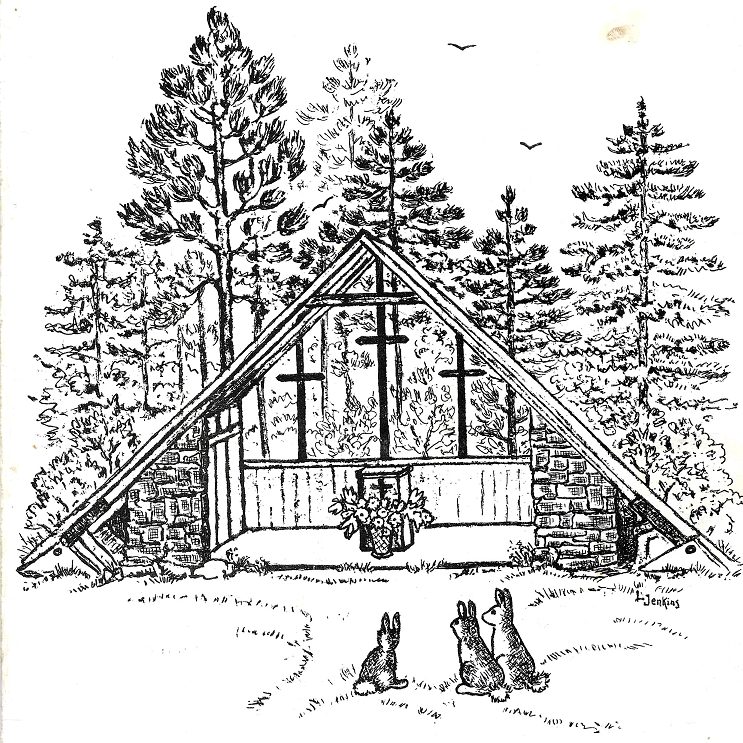
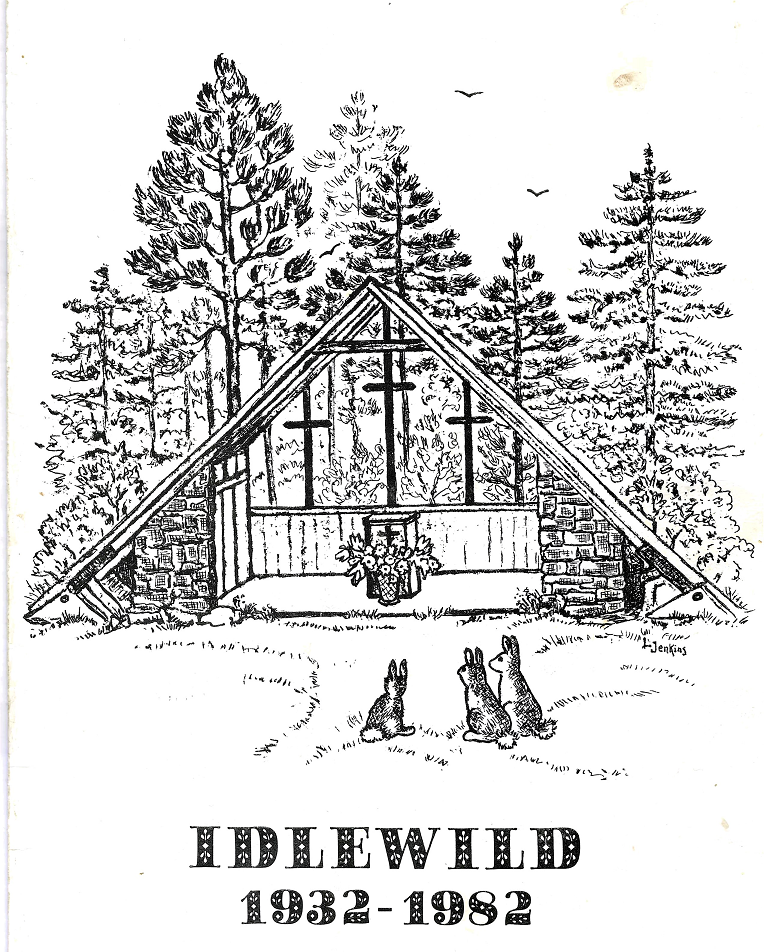
the financial holding of the community. More residents came, and more houses were erected. In 1959, Mr. Frank Stribling, with Mayme Marrs’ assistance, -surveyed and re-staked all Idlewild properties, including the lots and blocks on the new addition. On October 7, 1960, the present Worship Center property, consisting of two buildings and thirteen lots, was purchased from Mr. Cade of Tahoka, Texas for $3,000.00. In 1962, Mr. Fred Carlisle of Cimarron was contracted to erect the “A”- frame chapel for $1,500.00. For an addi tional sum of $300.00 he was to make an addition to the recreation building. During the summer of 1963, the first worship services were held under the pines in the new center.
The story of the Worship Center, its origin and its growth, is an integral part of the history of the Idlewild Community. The guiding spirit and influences which have welded the resort area into a commun ity were fostered by the dedication of its citizens to the purpose set forth in the Constitution. Mrs. Pearl Gould, with the assistance of serveral others, provided the leadership and in.spiration in the beginning of the church services. In the early days they started a Sunday School for the children of the community, holding it under the trees in the triangular plot in front of the Bratton cabin. With the encouragement and assist ance of dedicated resident ministers, this small endeavor grew to include church services, held each Sunday morning in the small spot. Rude wooden benches were provided by the men, a crude pulpit was fashioned of rough lumber, and attendance increases. With free-will offerings providing funds for necessary equip ment, eventually a portable field organ was purchased. Mrs. Buena Coleman of the mine area served as the faithful organist. From the beginning, church funds were set apart and separate from any other monies which accrued to the general fund in the hope that the Worship Center would be self-supporting.
-After the purchase of the Hardy Watson property, the adobe house became the center for religious, business, and recreational meetings. However, outdoor servfoes continued because the people enjoyed them. Attendance outgrew the space, and by popular demand, a committee was appointed by the Board of Directors to “look into the feasibility and possibility of securing a more desirable location”. In time, the purchase of the present worship site was made. Plans were formulated for the chapel, and the little cabin was set aside for visiting ministers and church staff members. Since that time, the worship services have grown and the center is the attraction and inspiration for peoples of all denominations or non-denomina tions. A committee appointed by the President of the corporation takes petitions from residents for ministers who come on vacation. The minister and his family live “gratis” in the provided cabin, and he provides sermon(s) and arranges worship services for the center while he is there.
Modern improvements and additions are constantly being added for the comfort of visitors to the chapel. An electric organ has been provided; folding chairs have replaced the old wooden benches; and new hymn books have been added for the benefit-of the church services. The Worship Center in Idlewild is in reality a sacred spot for the community.
The character of any community is determined by the character, interest, and aspirations of its citi zenry. Idlewild is what it is because of the caliber of the peoples who have made it a unique resort com munity. It stands as a monument to those men and women who realized the treasure they found and worked hard to preserve – for all – the ideals which they held. Nothing is perfect — not even Idlewild — but tourists from Oklahoma, Kansas, Texas, New Mexico, and some far-away places have come to stay, bringing their loved ones and friends to share in the pleasure they have found. Mr. Tom Cook’s find is truly an “IDLEWILD” for those who reside in the two-hundred or more homes spread out over the “two-hundred acre little bit of Heaven” in this land of Enchantment.
Many amusing and helpful comments were received with the questionnaires sent for information to Community property owners this year. Space and time prohibit adding them to this attempt to record the story of early Idlewild. One common theme, however, is the pride of accomplishment in family endeavors to build a place to “get away.” Idlewild is a community of “do-it-yourselfers” – from all walks of life – skill ed and unskilled in the building trades – all just plain folks with a single purpose. Neighbor helping neigh bor, they related how they donned working clothes and bent to the task of completing a desired quest for accomplishment and pleasure. Sore backs, skinned limbs, smashed fingers, roughened hands and sunburned faces were their badges of achievement contrubuting to the pride of a “mission accomplished.”
Today this story is re-enacted every day throughout the colony. Vacation time is the time to add on, to make improvements, to finish a job started earlier, to brighten up with paint, or to build a long-
planned house. The buzz of electric saws, the ring of hammers, the steady hum of well-drilling rig echo from dawn to dark. Sometimes a little time-off for fishing or sightseeing trip give rest from the task at hand. Work – hard work – goes on, but the gleam in the eye of the “little woman” or the delight of the children MAKE IT ALL WORTHWILE to the man of the hour – perhaps the curious tourist who came to see where IDLEWILD could be found!
Idle Moments At Idlewild
TALES AND TRIVIA GLEANED FROM COLONY RESIDENTS
A fellow who was in Idlewild honeymooning with his wife went “down the path” before dawn one morning. As he was returning to the cabin, he stopped dead in his tracks. Not twenty feet away sat a huge bear looking at him! What to do? That was the REAL question. He walked very slowly to the cabin pray ing that the bear would stay where he was. Fortunately, the bear didn’t move. Safe inside the cabin but still excited, our hero woke his bride to show her the bear and receive her kudos to his courage and bravery. But his moment of glory disappeared with the sunrise: His “bear” was the large burnt-out stump of a pine tree.
This is but one of many bear stories which have been recounted during the fifty years of Idlewild’s existence. None have been tragic (except for the bear in a case or two), but each in its own way has been exciting. No one has been hurt by a bear, but the animals have made people almost hurt themselves in try ing to get away from them – or what they THOUGHT was a bear.
One day during the off-season a large bear came down from the high country for some exploring and foraging. After snorting and sniffing around several cabins, he came upon the Rose family’s house. Mr. Bears’s inquisitive nature led him to look through a window where a curtain had been left partly open. There stood a huge bear looking back at him! With one swipe of his mighty paws, he broke the glass, climb ed through the window and prepared for battle to the death with his rival. What a shock it must have been to find that the other bear was only a mirrored image of himself! Enraged at being fooled by his own re flection, he wrecked the room, climbed through the window and went on his way leaving the result of his encounter behind.
During the 30’s, the WPA built many garbage pits with heavy covers in the colony. Residents could deposit their refuse in the. deep pits, replace the tight-fitting covers, and feel secure and safe from rummag ing bears. However, more than one bear was greedy and resourceful enough to mangle the lids and retrieve the odorous leavings. Two bears were unlucky enough to get down into the pits and become wedged in the hole. What noise they made in their anger at being trapped! Screams, roars, loud thuds and crashes attest ed to the futility of their entrapment. Forest rangers finally were forced to shoot them because they has so badly mangled themselves trying to get free.
One evening a family was out for a walk through the woods. Two or three children were running about, and a smaller child enjoying a ride on daddy’s shoulder suddenly shouted: “Look, Daddy! There’s a bear!” Sure enouth, blocking the path ahead was a mamma bear with her cub. The father didn’t know what to do, but he decided to just keep walking very slowly down the trail. Mother and children were screaming “Stop! Daddy! Stop!” But daddy kept walking slowly, ever so slowly. After what seemed an eternity, the bear turned, nosed her baby around, and they bounded off into the woods.
Many bears come down from the high mountains in search of food, even during the summer when there are people around. One family had hung a ham from the ceiling on their screened-in back porch and had put another in an old refrigerator by the kitchen door. Br’er Bear came lumbering down the moun tain, smelled the delicious ham odor, and went after it. He lacerated the porch screen with his claws and tore down the ham hanging from the rafter; then he caught the scent of the refrigerated ham. He knocked the box over, ripped off the door, and collected his second course before sauntering off to enjoy his meal. Rangers put an end to his escapade a few days later when they shot him with a tranquilizer, put him into a cage, and released him high up in the mountains.
One stipulation Mr. Gallagher made when he sold lots to early builders was that his cattle could graze wherever they wanted to. The woods were often visited by the large animals contentedly feeding on the lush grass, and occasionally one of the cows would bawl or moo loudly. Most people paid little atten tion to the noise. However, one woman who was out gathering pine cones was unaware of the grazing cattle. She was wearing bright red pants, bending and straightening as she busily tossed pine cones into a peach basket. Suddenly a bull roared lustily some distance away. Our woodgatherer stood rooted to the spot, her eyes wild and wide, her heart pounding. She took a tentative step, then another and another until she was running and stumbling pellmell faster and faster down the steep hill, scattering pine cones as she ran. “A bull’s after me! A bull’s after me!” She was finally caught by friends who reassured her. Her face and her pants were the same color of red when she realized that it was merely one of Mr. Gallagher’s cows talking to a “friend” across the valley.
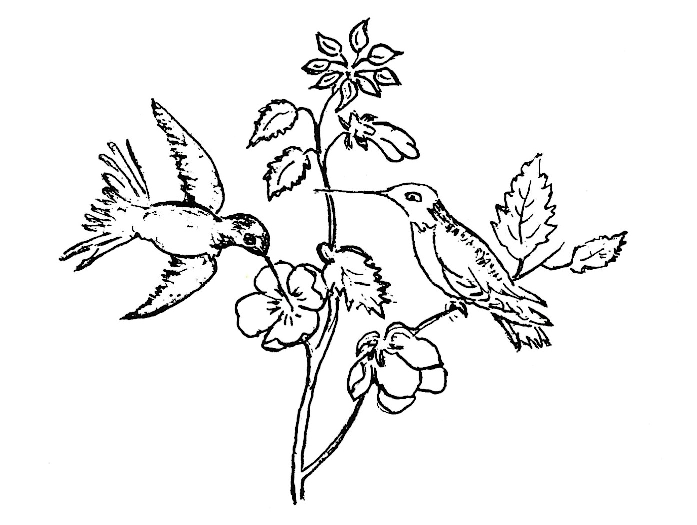
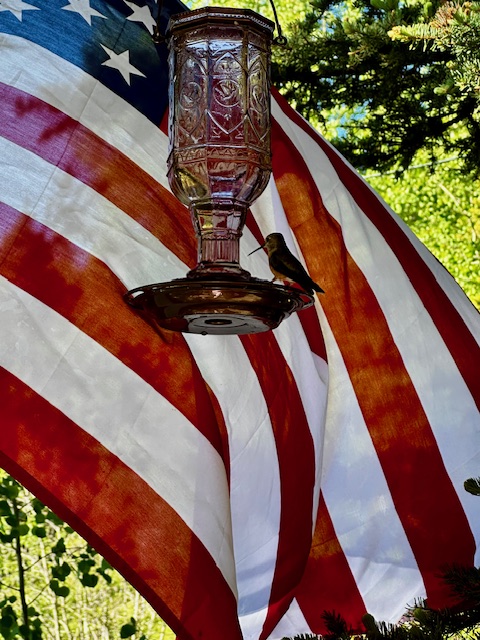
Bears and cattle are only a small segment of the animal life of Idlewild. Hummingbirds appear each summer and provide hours of interesting observation. They have been known to dash themselves against windows in attempts to get to the additional feeders they see reflected in the glass. Greedy and selfish over territorial rights, they wage fierce battles with intruders to defend their food source. Golden eagles are al most extinct in America today, but on occasion they may be seen flying high over a craggy peak or soaring through a valley. If he is lucky, the person walking toward the mine in the late afternoon may see one perched on a fence post or on a dead limb of tall pine tree.
Small animals abound. Little brown, striped chimpunks, beautiful white-tailed grey squirrels and cotton-tail rabbits play among the needle-laden tree branches and forest carpet. People who do not under stand the nature of wild animals have been bitten trying to catch or handle them. For some residents, how ever, patience has rewarded them in having the small beasties take bits of food from their hands.
Mule deer sometimes come down into the colony during the summer to find more succulent and tasty grazing. They are not the sleek, smooth-coated and beautiful deer seen on the plains, but they are fas cinating creatures to watch. On rare occasions a moose may be seen if one goes high up on the mountains follow- a jeep trail or hiking path. In late summer or early autumn, elk may be seen coming over a ridge down into the meadows below. Big bull elk with shaggy black neck, followed by his herd, is “Lord of all he surveys.” Herds of deer and velvety fawns are often seen in late evening in Cimarron Canyon.
Horses are a very popular mode of transportation – riding for fun and for seeing mountain country otherwise impossible to get to. Trips to Blue Lake, Horseshoe Lake and Lost Lake were once led by young sters Bil Gallagher, Bill Bratton and Jay Gould. Renting horses from the Gallagher Ranch, adventurous people made trips to the high country. Some trips were made in one day; other took two days or more with overnight camps alongside the lakes. Pack horses carrying supplies and surefooted mounts with riders aboard traversed the steep, winding paths to the high, crystal-clear, icy-cold waters. The Taos Indians rever ed the area for centuries as their ceremonial grounds, but they gave permits freely to campers. The bonus of large, delicious trout cooked over a campfire in the crisp mountain air made the arduous trip worthwile. Amusing experiences have been recounted by tenderfeet who made the trips – curiosity and adventurous spirit far outweighing their endurance. Many riders who considered themselves to be tough enough for such a trip found sitting and walking uncomfortable for days.
Walking has always been a favorite pastime for ldlewilders. In the early days of the colony, people walked the mile or so down the winding dirt road to the Gallaghers where they could buy fresh milk and eggs, and several varieties of fresh vegetables. A more taxing jaunt up the long, steep climb to Willow Creek rewarded the more hardy hiker with fresh eggs from the chicken ranch located there. Or a hike down to the “old mine” has always been a real treat. The Klondike Mine, across the cattle guard and further up the valley, closed in 1926. “Old Ed”, the caretaker, lived in one of the cabins until he died in the late 30’s or early 40’s. A pleasant diversion for children sometimes became a frightening experience when they en countered “Crazy Ed, ” as they called him. He was a welcome deterrent for many children whose parents had warned them about wandering off too far.
Before the new Red River highway was built, the “chills” took precedence over the “thrills” of the road. Steep, narrow, rough, unpaved, the road with its sixteen hairpin turns caused many bad accidents through the years. But one grimly humorous story is told of a carload of intoxicated men going UP the Pass from Red River to Eagle Nest. They failed to make a curve, rolled over and over down the steep em bankments until they landed right-side-up several levels below – headed in the opposite direction. They kept right on going – back to Red River! Quite often people who went over the Pass refused to return to Eagle Nest if they had to negotiate the same route. Fortunately for those more cautious folk, they could drive from Red River through Questa to Taos, then over the Taos Pass Pack to Eagle Nest. Driving sixty miles was far more sensible to them than the sixteen or so back over the “suicide” pass.
Recreation today is quite different from the early days. Neal’s Store and the American Legion Hall in Eagle Nest were gathering places for everyone in Moreno Valley. On Saturdays, folks took out a galvan ized tub, carried and heated water on a wood stove, scrunched and squeezed themselves into the tub and took a weekly bath – “all over”. About sunset, they would head for the dance downtown. A string band
playing “Put Your Little Foot,” “Ten Pretty Girls,” “Cotton-Eyed Joe”, waltzes, polkas, squares and other folk dances would continue as long as anyone was left to dance. Mr. and Mrs. Gallagher were the “Old Smoothies” of the Saturday night dances, and – expert or novice – people danced (or watched) for hours Many who “wouldn’t be caught dead at a dance hall” were the most regular in attendance each week!
Open gambling was active in the bars, furnishing amusement and loss or reward for those who want ed to take the risk. Fortunes, ranches, homes and family possessions changed hands often during the course of the lengthy games. The Post Office, located in Neal’s Store, was the town’s most popular place. Resi dents arrived before the mail was put up to buy a few provisions and exchange all the latest “doings” of the area. Kerosene for lamps, ice for ice boxes, pinto beans, potatoes, and flour for breakfast biscuits made grocery shopping worthwhile.
Picnics and pot-luck suppers have always been popular, with dominoes, bridge, bingo, 42 or sing alongs following the feast. They were held down in the canyon, out under the trees in someone’s backyard, or (later) in the community center in town. The whole family would go and enjoy the fellowship with others.
Fishing has long been one of the prime attractions around Eagle Nest. During May in the 30’s and 40’s the lake was seined and the fish were taken on ice to a clearing near the Palisades in Cimarron Canyon, dusted with cornmeal and cooked in 40-gallon drums of grease boiling over log fires. Anyone could go and, for a small price, eat all the fish and French fries he wanted. Fishermen who had no luck in the Cimarron River could eat to their heart’s content while describing to other luckless·sportsmen how all the “big ones” got away during the day. There is absolutely no way to estimate how much money is represented by the lures, flies, line, sinkers, flats, broken rods and reels, and bait caught on gooseberry bushes, trees, rocks and beaver dams along the river in Cimarron Canyon! For unskilled fishermen it was (and is) cheaper to go to the Laguna Vista in Eagle Nest or one of the restaurants in Red River and order a big trout dinner.
Building cabins has •long been the principal “diversion” for property owners. Stories about how these people found Idlewild, how and when they acquired their property, and the experiences they had while building are varied and interesting. One heir to lots made this reply to the questions concerning any information he might have about the colony:
“Perhaps it was won in a poker game – I’m not sure. Anyway, we used to go up to Idlewild for the summer from Phillips, Texas, where Dad was employed. It was great fun. I used to save my money so I could ride a horse named “Bonny” I rented from Gallaghers. Imagine my dismay when I went up one sum mer to find that Bonny had been sold for Fox Feed.”
Another proud cabin builder answered: !’When we bought our lots, Mr. Marrs was showing the property. There were two cabins on the ‘East Forty’ as we called it. So, four years from the date of pur chase, we camped on the spot and, as a family, began to build. The main structure went up in a month – that was our vacation. The next summer we put the outside finish on and built the deck When we first
built, we could see deer wandering around our cabin frequently. Elk sometimes grazed in the field nearby. Sometimes at night we could hear wild animals – coyotes, bears, a bob cat. Once we thought we heard a cougar scream in the night. Wild flowers were abundant. Squirrels and chipmunks ate from our hands.”
Stories about persons who comprise the citizenry of a community are always interesting. Dr. W.K. Waters, a Presbyterian minister from Overland Park, Kansas, was a leader in Idlewild Community and in the Worship Center. Many of his parishoners followed him to Idlewild and settled on the “East Forty.” His son remembers: “My father began coming regularly to Idlewild in 1935 when his cabin was built. It was that summer that he was requested to teach a Sunday School class each Sunday. This was followed by: ‘If you’re going to teach the class, you may as well preach, too!’ He did – for many years. In 1968, the year he died, he received a plaque from the colony honoring him for the many years of service he had put in at Idlewild.”
A property owner who resides in Seattle, Washington, gave this interesting information: “I am in possission of an Abstract of Title, apparently executed in 1936 at the time my grandfather purchased the property. The first entry of this abstract indicates conveyance of ‘915 acres more or less’ from the Board of Trustees of the Maxwell Land Grant Company by Frank Springer, President, to Herman Froelick by Warranty Deed dated September 6, 1904. The abstract lists all recorded transactions and subdivisions of
the original parcel up to 1936 when my grandfather purchased it (including the Dickerson subdivision).” This instrument is one of the early abstracts furnished to Idlewild property owners. The Gallaghers pur chased their homestead from Herman Froelick.
Throughout this narrative people have been remembered for their contribution in making Idlewild
what it has become. There is no one who is more responsible for its being – and remaining – the beautiful, peaceful, vacation paradise it is than Mayme Marrs. She and Britt came to Idlewild in 1935. He worked with the highway department, but he also helped build porches, additions, out-buildings, and roofed and slabbed cabins for summer residents. Britt and Mayme first lived in a very small house at the bend of the road leading up to ldlewild. They have two children: son “Butch”, a college graduate, is an employee of the New Mexico Highway Department; Lou Abernathy, their daughter, has taught school for several years in Cimarron. She has her Master’s Degree, and is quite talented in music. Britt and Mayme worked very hard to provide a good home and education for their children. Since the early forties, Mayme has lived at the entrance to ldlewild. After Britt died, she stayed on and still cares for the cabins in the colony, cuts down trees, stacks wood, does plumbing, opens cabins for residents on the way out for the summer, handles sales of lots and property, recommends builders and/or carpenters, takes messages, chases off undesirables – you name it and Mayme has done it! She is a good friend, a loyal and trustworthy caretaker, and an abso lute necessity for all property owners of Idlewild. She is ONE GRAND LADY!
Lots of changes have taken place in Idlewild since people discovered this little piece of heaven. Cabins have popped out like measles. Electric lights how bum brightly where kerosene lamps used to glow dimly through the trees. Gutters run around eaves and empty into large storage tanks hooked up to electric pumps for indoor bathrooms. Some cabins have drinking water piped in from wells. Many cabins now are built of man-made materials instead of logs and slabs; designs vary from crude square cabins to Swiss-style chalets. Galvanized wash tubs for bathing have been replaced by plastic or tile tubs; bottled gas now bakes biscuits instead of the old pot-bellied or little “Comfort” iron stove. Funiture of the latest design, carpet, draperies, beautiful pottery for dining, and stainless steel flatware have added the “modern” touch to most cabins. Television, stereo, short wave or citizen band radios and telephones are “necessities” for ·many owners nowadays. Freezers and refrigerators have replaced the little window coolers covered with wire screen. No longer do folks have to break the ice in the water bucket on the back porch before they can brush their teeth. (The seasons have changed as have the times.) Washday holds no fears now; women once used a big black iron pot sitting over a fire pit for washing the soot and black dirt from the family’s clothes. Toasters, mixers, blenders, electric coffee pots, electric blankets, and vacuum sweepers make “roughing it” much easier these days. Yes, times have changed in ldlewild, and to those of us who “pio neered”, some of the charm is gone. But the one thing that has really “made” the place so special is the people who were, who are, and who will be there; for Idlewild is a heritage worth passing on to future gen erations who want a little preview of what heaven is.
The March of Progress
Is it really worth it? Progress, I mean. Here I sit in a mountain cabin typing on an electric typewriter, my work illuminated by an electric lamp, the teakettle whistling merrily on the back burner of a butane range, a transistor TV playing across the room, and my husband taking a shower in the bathroom. THIS IS ROUGHING IT?
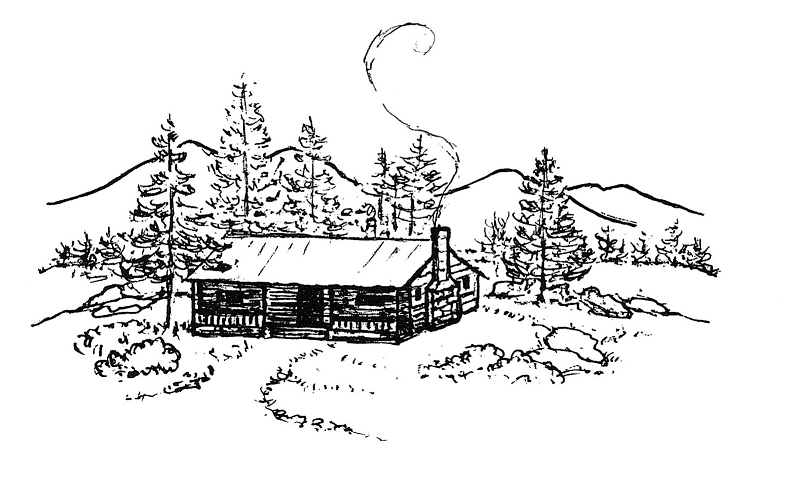
I first came to this pine-covered paradise during the dustbowl days of the 30’s. After being buried alive in dust for nine months of the year, we looked forward to these green, cool, clean mountains of northern New Mexico – a veritable Garden of Eden. We lived in a log cabin divided into two rooms – one a bedroom, the other the kitchen/living area. There was a small iron wood-burning stove for heat and cooking our meals, pails of cold mountain spring water for drinking (that we’d laboriously carried several hundred yards uphill from the creek), kerosene lanterns for light, and thick feather mattresses on crude bunks for sleeping. Now THAT was roughing it!
I can remember waking in the morning and watching my steamy breath rise in the cold, crisp air inside the cabin while I snuggled even deeper into the soft, warm feathers of the mattress. I could hear Dad chunking kindling and rich pine knots into the little stove. Pop! Hiss-s! Cza-a-ack! The resinous pine burst into flame in the firebox. The teakettle began to gurgle, hesitantly at first, then more confidently. The coffee pot harmonized with the kettle in a rhythmic excellence of pops and perkles. Dad would call: “Babe, jump out of bed and come in by the fire.” Reluctantly I took a deep breath, bravely threw back the heavy plaid made quilts, grabbed my robe from the foot of the bed, stepped to the cold linoleum floor, and went into the kitchen. A chair near the stove and a big log for my feet to rest upon waited for me. Mother and Dad, much braver than I, had got up when it was still cold, made the fire, and splashed their faces in icy water from the bucket by the door.
By the time I was warm, the tantalizing odor of bacon, the sizzling and popping of eggs frying, and the subtle aroma of biscuits browning in the oven filled the little cabin. Somehow these ordinary foods smelled and tasted better than anywhere else at any other time. Breakfast was a real treat when the three of us were snug and safe at the table near the little stove.
After breakfast, we had the cleaning up to do. From a metal dishpan sitting atop the stove we washed the dishes, dried them, and replaced them on the rough shelves which served as a cabinet. Then we brought in armloads of wood to replenish the empty wood box, cleaned and filled the kerosene lamps, and swept the soot and pine needles from the floor. The old braided-rag rug was tossed over a makeshift clothesline outside and beaten to remove the dirt and dust. Beds were smoothed and plumped, pillows fluffed, and extra covers folded and stacked atop a crude stand in a corner.
Chores done and cabin cleaned, we took care of our own personal needs. Standing on the back porch with a cup of water in our hand and toothbrush in the other, we scrubbed our teeth and rinsed, splattering white foamy used toothpaste on the rocky ground. We washed our faces with the warm water left in the teakettle, then donned our jeans, heavy wool shirts and boots. Now we were ready for whatever the day might bring: hiking, exploring, fishing, trips to Taos or Red River, or just being lazy.
About one mile south of our cabin and over two small mountains was a beautiful valley with a little stream meandering through it. Six-Mile was the epitome of a mountain wilderness valley and we loved going there. Sometimes we took a lunch with us, or sometimes we took a fishing rod in hopes of hooking a rainbow trout. It didn’t really matter what we did when we got there, just being there was reason enough for going. The trek was difficult over the rocky terrain, and our breath came in aborted gasps as we stumbled and walked, but even this didn’t diminish the prospect of what awaited us.
All kinds of flora and fauna called Six-Mile home. fat chipmunks, cottontail rabbits, Stellar jays, robins, mountain tanagers, deer, the occasional bear high up in some rocky crevice, and tiny busy hummingbirds. Thick lush green grass, more wildflowers of all kinds and colors; gooseberry bushes along the stream; pine, spruce, and pine trees grew in profusion everywhere. The peace and quiet were deafening and awesome – both at the same time. Surely no place on earth rivals it for natural beauty.
Some days the clouds gathered and grew dark by mid-morning. Raindrops began to fall, softly and intermittently at first, then growing in intensity until they drummed a continuous staccato on the metal roof. Steady drips grew into small waterfalls from the eaves and beat mininature trenches evenly around the foundation of the cabin. Showers didn’t usually last long and the sun shone brightly before the last drips came to rest. The forest looked like a giant mound of shimmering, shining jewels where the sun re flected the light of the wet droplets on pine needles and branches. Flowers which had bowed their blos somy heads to the weight of rain now raised them to smile and look at a fresh, clean world. Chipmunks, squirrels, and rabbits crawled out from their day havens to look around, and birds flapped and beat their wings to dry themselves. A day like this was perfect for reading or some kind of fancy handwork – if you could manage to keep your mind on it while Mother Nature competed for attention.
There were other things to do besides walk to Six-Mile or listen to the rain on the roof. A few miles away by car was a winding canyon cut by eons of water and wind erosion. It was rich in pines, spruce, mountain junipers, gooseberry bushes, willows, yucca, and wild flowers. A stream – now lazy and slow, then rushing and impetuous – was a natural fisherman’s paradise. We might take a picnic lunch along, or, if we felt especially lucky, we took grease, cornmeal, cooking utensils, and fishing gear for a fish dinner. An open campfire.with its pungent wood smoke curling restlessly on the light air and a cold mountain stream nearby made an inviting kitchen. Whether we caught a trout to cook over the fire was immaterial; bacon, scrambled eggs, and hash brown potatoes tasted just as good.
Saturdays were special days. The old joke about the Saturday-night-bath was no laughing matter. We’d get out the galvanized wash tub, heat buckets and kettles of water on the stove, then take a bath. We could only do it once a week because of the scarcity of water, so we made it last. I was first; then Mother; then Dad. (That Dad was really clean by the time he got his bath is moot point, but at least he FELT that he was clean!) A blanket or sheet strung over the rafters afforded some privacy to the person bathing and held out the cooler air.
Cleaned and dressed, we went down to the little village of Eagle Nest for a change in scene. A gen eral store which also served as the Post office, a motel of sorts, a couple of filling stations, and about six or eight bars comprised the town. During those days New Mexico was wide open for gambling, and Saturday nights meant that cars bearing out-of-state licenses would line both sides of the single street. For those who had already gone broke gambling or who preferred it, a dance would begin about eight P.M. Square dances, polkas, waltzes, and every kind of folk dance were the rule. A local group played: two fiddles, a banjo, a string bass, a guitar, and sometimes a drum. They may not have been Broadway caliber, but they could play foot-stomping, toe-tapping music. Everyone for miles around came and “had a ball.” No liquor or gambling were allowed in the dance hall; if you wanted that type of excitement, you had to go across the street or nextdoor. ‘
A trip to Red River was a favorite thing to do. The first ten miles or so of the dirt road was a typ ical scenic drive, but abruptly the road took a sharp uphill turn and spiraled round and round a mountain – sixteen hairpin turns in all – until it leveled and straightened at the limits of the resort nestled amoug tow ering peaks in the Red River Valley. It was a more “wide open.” town than Eagle Nest with more bars and gambling rooms, a restaurant or two, several motels, and a roller skating rink. Horses were available to rent by the hour for exploring deserted canyons, or one could take a tour of the valley on an open-roofed bus.
For a real change in scene, a trip to Taos over a mountain pass and through a lush mountain valley was a “must”. After winding around and up and down, the road emerged in the very old town resting on a plain at the western base of the Sangre de Cristo mountains. A mixture of Indain, Spanish and Anglo cul tures made this a truly unique place. North and east of town stood the Taos Pueble where the Taos Indians have lived continuously since it was built centuries ago. In the center of town, a plaza filled with flowers, statues, walks, and handy stone benches invited blanket-wrapped Indians to sit and visit or pose for pictures by tourists. Curio shops, Kit Carson’s home and museum, and other historical shrines in and around the plaza were sights to see. Artists and writers from everywhere found Taos a place where they could truly communicate and create for profit.
People came to New Mexico for many different reasons, but for us it was a chance to clear the Pan handle dust from our lungs and rest. Many hours could be spent in reading, napping, walking or just look-
ing. Regardless of how long we could stay, we always looked forward to the change and dreaded the thoughts of leaving. It is still that way today. Automobiles and highways make the trip easier and quicker, but the same emotions are present when one has to close the cabin for the winter and go back home. There was not nearly so much to do before leaving thirty-five years ago, but the extra time it takes to drain the water tank and hot water heater, turn off the butane, and lower the TV aerial does give us that extea few minutes we didn’t used to have. Too, the wall switch is handier than the kerosene lamp, the water tank is less work than carrying buckets of water uphill, the butane is quicker than building a wood fire, and an in side bathroom beats a path out the back door! But it isn’t quite the same. It is nice to remember and talk about those days past, but middle age has taught me to appreciate progress – even when getting away from it all.